Hear from Our Customers
A crack in your parking lot isn’t just an eyesore. In central Maryland, that crack is an open door for water and once water gets in and the temperature drops below freezing, it expands, widens, and starts undermining the base layer underneath. By spring, what was a $10,000 repair has a real shot at becoming a $40,000 reconstruction. That’s just how freeze-thaw cycles work in the Fort Meade area.
The Fort Meade corridor carries a different kind of traffic than most commercial areas in Anne Arundel County. Government vehicle fleets, defense contractor operations, delivery trucks, and the daily commute of tens of thousands of workers create pavement stress that residential-grade installation simply wasn’t built for. When asphalt is under-spec’d for the load it’s actually carrying, it fails faster and the repair bill reflects it.
There’s also the ADA piece. The workforce and visitor population around Fort Meade includes a significant number of veterans and active-duty service members. Faded striping, non-compliant accessible spaces, and deteriorated lot markings aren’t just a code violation they’re a liability and a statement about how seriously you take the people walking into your facility. A properly installed and maintained commercial lot handles all of this at once: durability, compliance, and a surface that looks like you’re running a professional operation.
We’re based in Annapolis about 20 minutes from Fort Meade via MD 32 and MD 175. That proximity isn’t a selling point for its own sake. It means faster site assessments, tighter project oversight, and someone who can actually be on-site when something needs attention rather than dispatching a crew from three counties away.
We hold Maryland MHIC License #159766 and have earned a BBB A+ accreditation credentials you can look up and verify, not just claims on a webpage. That matters in a market like the Fort Meade corridor, where facility managers and property owners are used to vetting vendors carefully before signing anything. Our principals bring over four decades of combined industry experience to every commercial project, and we’ve been operating in Maryland and Virginia for more than 14 years.
We’re not a residential paving crew that built a commercial landing page. We handle the full scope installation, resurfacing, sealcoating, crack repair, and ADA-compliant line striping for commercial properties across Anne Arundel County and beyond.
It starts with a free site assessment not a sales call. Before anything is quoted, we evaluate your lot: drainage patterns, subgrade condition, current surface deterioration, traffic load patterns, and ADA compliance status. For properties along the MD 175 commercial corridor or in the Annapolis Junction Business Park area, that assessment often turns up drainage issues that aren’t obvious from a visual pass but will cause early pavement failure if they’re not addressed before the first inch of asphalt goes down.
Once the assessment is complete, you get a detailed written proposal. The scope, the spec, the timeline all of it in writing before any work begins. For commercial paving in Anne Arundel County, that proposal accounts for applicable county permitting requirements and ensures the installation meets the commercial-grade specifications your property actually needs: typically 4 or more inches of asphalt depth for high-traffic commercial use, not the lighter residential spec that some contractors quietly substitute to cut costs.
Installation is phased wherever access continuity matters and near Fort Meade, it often does. Facilities serving defense contractors or government-adjacent operations frequently have specific access requirements that can’t simply be shut down for a week. We schedule and sequence work to keep your operation running. After installation, the process doesn’t stop: sealcoating within the first year, a maintenance program that includes crack filling and restriping on a defined schedule, and a surface that’s built to hold up through Maryland winters rather than just look good on day one.

Ready to get started?
Commercial asphalt paving near Fort Meade isn’t a single service it’s a set of decisions that compound over the life of your pavement. We handle every stage of that lifecycle for commercial property owners in the Fort Meade corridor, from new lot installation and full-depth reclamation to overlay resurfacing, protective sealcoating, and ADA-compliant line striping and pavement markings.
The parking lots and access roads built during the BRAC construction wave between 2005 and 2015 are now 10 to 20 years old. That’s the age range when commercial asphalt especially surfaces that missed regular sealcoating cycles starts showing serious deterioration. Resurfacing an existing lot is often the right call at this stage: it preserves the base layer that still has structural integrity, restores the surface to commercial standard, and costs significantly less than full replacement. Whether resurfacing makes sense or full reconstruction is warranted depends on what the subgrade assessment shows and that’s exactly what the initial site visit is designed to determine.
Sealcoating is included as part of a complete commercial paving program, not treated as an upsell. In Maryland’s climate, the oxidation process that makes asphalt brittle and crack-prone accelerates without a protective sealant layer. Applied within the first year of installation and maintained on a 3 to 5 year cycle, sealcoating is the single highest-return maintenance investment a commercial property owner in this area can make. Line striping, ADA space designation, and van-accessible markings are handled to federal compliance standards because in a community that serves as many veterans and service members as the Fort Meade area does, getting that right isn’t optional.
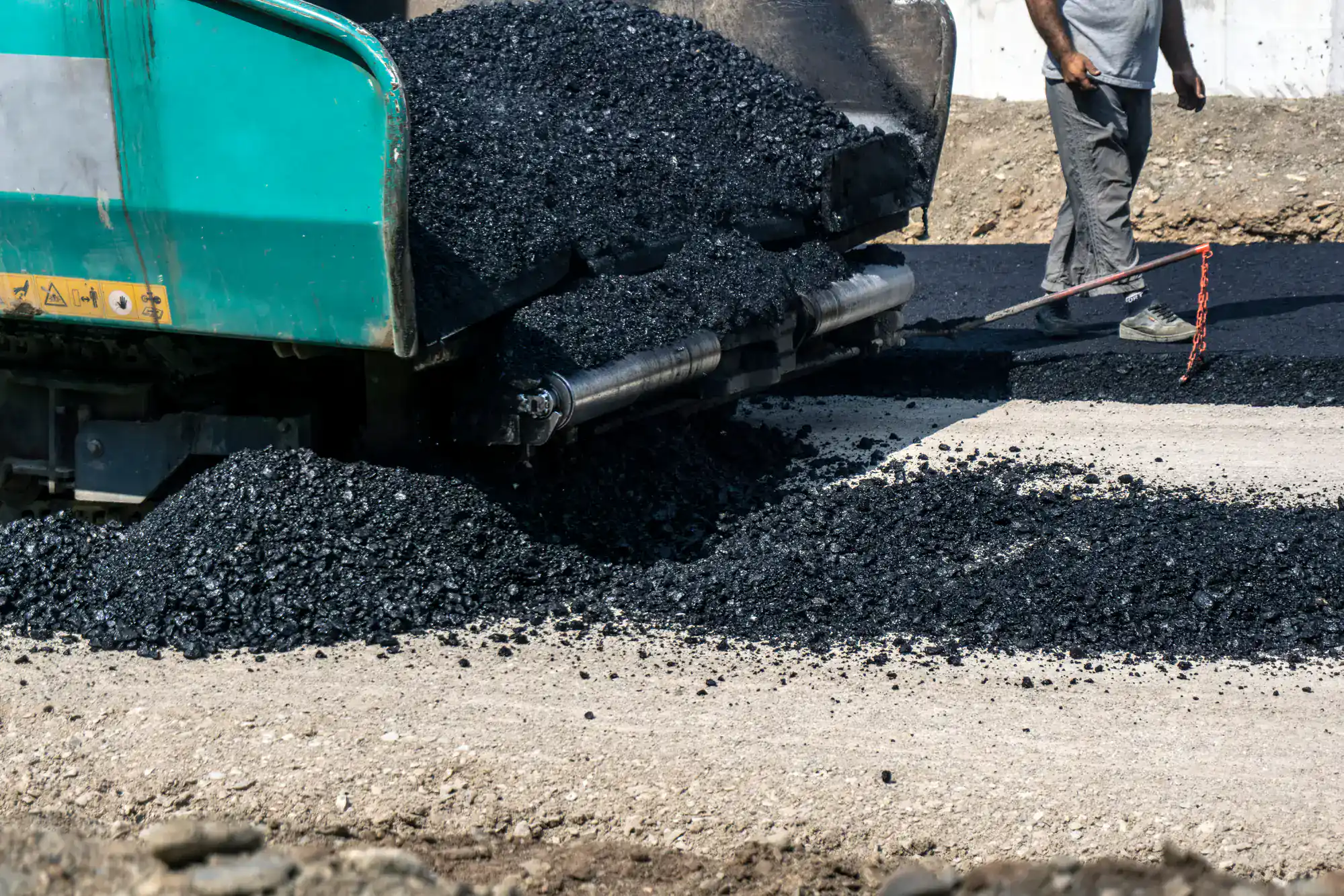
For standard commercial parking lots, the industry specification is a minimum of 4 inches of compacted asphalt over a properly prepared aggregate base. For lots that carry heavier loads delivery vehicles, government fleet vehicles, or the kind of sustained high-volume traffic you see on the commercial corridors along MD 175 and MD 32 near Fort Meade 4.5 to 5 inches is often the more appropriate spec. The base layer matters just as much as the asphalt itself. A well-graded, compacted aggregate base of 6 to 8 inches is what gives commercial asphalt its load-bearing capacity. Without it, even properly spec’d asphalt will start failing under repeated heavy loads.
This is one of the most common places where commercial paving projects go wrong. A contractor who installs residential-grade asphalt thickness on a commercial lot 2 to 3 inches instead of 4-plus will produce a surface that looks fine on day one and starts cracking and rutting within 2 to 3 years under commercial traffic. The spec conversation should happen before any work is quoted, and it should be in writing.
Commercial asphalt paving costs vary depending on lot size, current surface condition, drainage requirements, and the scope of work new installation, resurfacing, or full reconstruction. As a general range, new commercial asphalt installation in the Anne Arundel County area typically runs between $3 and $7 per square foot, with full reconstruction on the higher end of that range and overlay resurfacing on the lower end. A 10,000 square foot commercial lot might run $30,000 to $50,000 for full installation, depending on site conditions and base work required.
The more useful number is the total cost of ownership over 20 to 25 years. A lot installed to the correct commercial spec, sealcoated within the first year, and maintained on a regular crack-fill and restriping schedule will cost significantly less over its lifetime than a cheaper initial installation that starts requiring major repairs within 5 years. For commercial property owners in the Fort Meade corridor managing significant assets, that long-term math is worth running before making a decision based on the lowest bid.
Fort Meade’s location in central Anne Arundel County means it experiences more pronounced freeze-thaw cycling than waterfront communities closer to the Chesapeake Bay. The bay moderates temperatures along the coast Fort Meade doesn’t get that buffer. What that means practically is that any water that has penetrated existing cracks in your asphalt surface will freeze, expand, and widen those cracks every time the temperature drops below 32 degrees. Over a typical Maryland winter with multiple freeze-thaw cycles, small surface cracks become structural damage.
The protective measure is straightforward: keep water out of the surface. That means crack filling before winter, sealcoating on a regular cycle to slow oxidation and surface porosity, and ensuring your lot has proper drainage so water isn’t pooling and sitting on the surface in the first place. Commercial properties that skip these maintenance steps for a few years often find themselves facing resurfacing or reconstruction costs in the spring that dwarf what the maintenance program would have cost.
For most commercial paving projects on properties outside the Fort Meade installation boundary, Anne Arundel County building permit requirements apply. Whether a permit is required depends on the scope of the project new installation and full reconstruction typically require permits, while maintenance work like sealcoating, crack filling, and restriping generally does not. The county also enforces ADA compliance standards for commercial parking lots, which govern the number of accessible spaces required, van-accessible designations, signage specifications, and cross-slope limits on accessible routes.
We hold Maryland MHIC License #159766, which is the state-level contractor credential required for this type of work in Maryland. The licensing requirement exists to protect property owners it requires passing a state exam, demonstrating documented experience, and maintaining proper insurance. If you’re working with a contractor who can’t provide a verifiable MHIC license number, that’s a significant red flag regardless of how competitive their price looks.
The practical installation window for commercial asphalt in Maryland runs from late April through October. Asphalt needs to be laid and compacted at the right temperature too cold and it won’t compact properly, which leads to premature surface failure. The spring and early summer window is typically the busiest for new installation and resurfacing projects, as property managers are assessing winter damage and scheduling repairs before the summer heat arrives.
Fall specifically September and October is the most important window for sealcoating. Sealcoat needs to be applied when temperatures are consistently above 50°F and the surface is dry. Once temperatures drop into the 40s overnight, the application window closes until spring. Commercial property owners in the Fort Meade area who want to protect their surfaces before winter should plan sealcoating for early fall, not after the first freeze. Missing that window means an entire winter of unprotected oxidation and freeze-thaw exposure which accelerates the deterioration timeline measurably.
The Fort Meade corridor has attracted a wide range of paving contractors, and not all of them are operating at a commercial standard. The clearest filter is the Maryland MHIC license it’s publicly searchable, and any contractor doing this type of work in Maryland should be able to give you a license number you can verify. Beyond that, ask specifically whether the contractor has experience with commercial-grade installation, not just residential driveways. Many operators who appear in local search results for Fort Meade are primarily residential paving crews who have created commercial-sounding web pages. The proposal they give you will usually reveal the difference a commercial contractor will specify asphalt depth, base preparation method, drainage design, and ADA compliance scope in writing. A residential crew will give you a price per square foot and a handshake.
BBB accreditation is another useful signal in this market. The defense-sector professional community around Fort Meade is accustomed to vetting vendors carefully, and a BBB A+ rating like the one we hold is an independently verified indicator of business accountability that you can check before signing anything. Get at least two detailed written proposals, compare the specs not just the prices, and ask any contractor you’re considering for their MHIC license number before the conversation goes any further.
Other Services we provide in Fort Meade