Hear from Our Customers
Southern Maryland winters are not gentle. Temperatures in St. Mary’s County drop below freezing dozens of nights a year, and every one of those freeze-thaw cycles works against whatever cracks are already in your driveway. Water gets in, freezes, expands, and by spring what looked like a surface issue has become a structural one. A properly installed asphalt driveway built with the right base depth and compaction is designed to flex through that cycle instead of fracturing under it.
For Callaway specifically, the older housing stock creates a different kind of demand than you’d see in a newer development. When a driveway has been down since the Reagan administration, the base has shifted, the surface has oxidized past the point of sealing, and the drainage that was once adequate may not be anymore. What you actually need is a full replacement done right not a cosmetic fix that buys you two seasons.
There’s also the rural factor. More than half of Callaway residents live on larger properties, which means longer driveways, more complex grading, and a project scope that’s nothing like a standard 20-foot suburban apron. When your driveway runs 100 to 200 feet off Point Lookout Road, every inch of it matters and so does the crew doing the work.
We’re a family-owned asphalt paving company that’s been passed down through three generations. That’s not a marketing angle it’s what separates a contractor who’s still around when you call two years later from one who’s in a different county by October. The Southern Maryland paving market has a real problem with seasonal operators who take deposits and disappear. We’re not that.
We hold Maryland Home Improvement Commission License #159766, active through August 2026 a credential you can verify yourself at labor.maryland.gov in under a minute. We’re also BBB Accredited, which means we’ve met third-party standards for accountability and transparency. For homeowners in Callaway who’ve heard the horror stories from neighbors, those aren’t small things.
We operate our own equipment Bobcat, dump trucks which matters on rural Callaway properties where longer driveways require real machinery and a team that knows how to use it. No subcontracted labor, no unknown crews. You know who’s showing up.
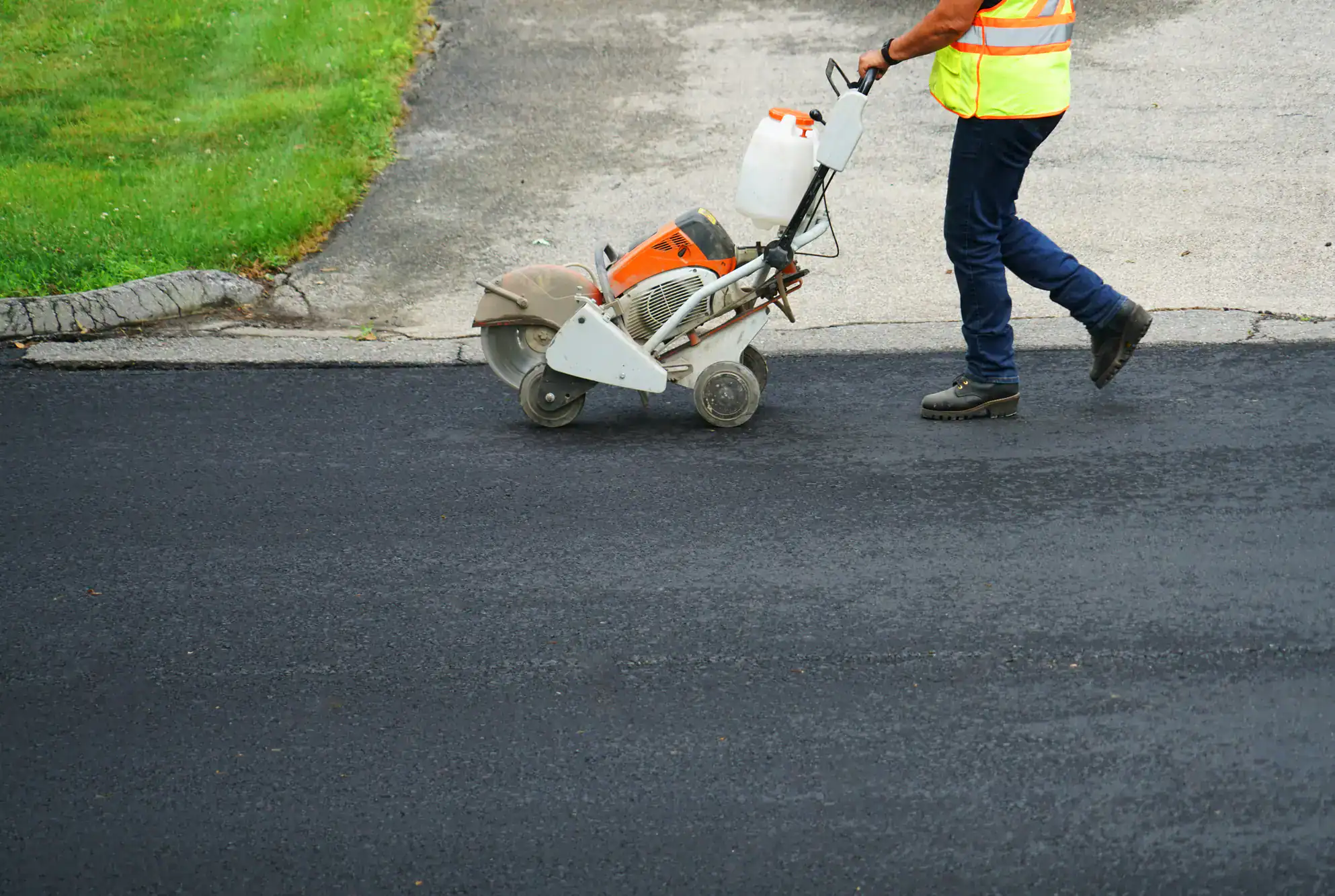
It starts with an in-person estimate not a phone quote based on square footage, not a ballpark pulled from a website calculator. Someone from our team comes to your property, walks the driveway, assesses the grade, looks at how water moves across the surface, and gives you a written number you can hold us to. For Callaway’s rural properties, that site visit is not optional. Every driveway is different, and the ones that run back from MD-5 or MD-249 have conditions a phone call can’t account for.
If your driveway connects directly to Maryland Route 5, there’s a state permit involved. The Maryland State Highway Administration requires a residential entrance permit for any new or modified driveway connection to a state-maintained road. We handle that process as a licensed contractor. An unlicensed operator typically skips it, leaving you with a compliance issue you didn’t know you had.
Once the scope is confirmed and permits are handled, the work follows a clear sequence: old surface removal, base grading and compaction, drainage correction where needed, and asphalt installation in the right thickness for the application. The driveway needs 24 to 48 hours to cure before you drive on it. After that, it’s yours and with sealcoating every two to three years, especially given the humidity and salt air in lower St. Mary’s County, it’s built to hold up for 20 to 30 years.
Ready to get started?
We handle the full range of residential asphalt driveway work new installation, full replacement, resurfacing, and sealcoating. For Callaway homeowners, the most common need is full replacement. The 1980s housing stock in ZIP code 20620 means a large portion of driveways in this area are 35 to 45 years old, which is well past the point where resurfacing makes financial sense. When the base has failed, putting new asphalt over old problems just delays the inevitable.
For properties with gravel driveways common on rural lots throughout the Valley Lee area a gravel-to-asphalt conversion is a full-scope project that includes base preparation, proper grading for drainage, and installation of a surface that’s going to hold up under vehicle loads and Maryland winters without rutting or washing out. These projects are larger and require the kind of equipment and crew size that a serious paving company actually brings to the site.
Sealcoating is offered as a standalone service and as part of a long-term maintenance approach. In coastal Southern Maryland, where properties sit within a few miles of the Potomac River and Chesapeake Bay watershed, the combination of humidity, salt air, and summer UV exposure accelerates asphalt oxidation faster than it would in an inland market. Sealing on a regular schedule is what keeps a new driveway looking and performing the way it should not something you do once and forget.
The honest answer is that it depends on your specific property and in Callaway, that variability is wider than most places. A standard residential asphalt driveway nationally averages around $5,275, with most projects falling between $3,149 and $7,448, or roughly $6 to $9 per square foot installed. But those numbers assume a fairly typical suburban driveway of around 600 square feet.
In Callaway, a significant number of properties have rural driveways that run 100 to 200 feet or more from the road to the house. A 200-foot driveway at a standard 12-foot width is 2,400 square feet four times the national average scope. That changes the budget significantly. Gravel-to-asphalt conversions add base preparation costs on top of the surface installation. And if your property fronts on MD Route 5, there may be permit costs involved for the driveway connection to a state road. The only accurate way to price a Callaway driveway is with an in-person estimate from someone who has actually seen the site.
The general rule is this: if the damage is surface-level isolated cracks, minor oxidation, a few rough patches resurfacing or crack filling can extend the life of what’s there. But if the base has failed, if you’re seeing alligator cracking across large sections, if the driveway heaves or sinks in spots, or if it’s simply very old, you’re not going to patch your way to a durable result. You’re just spending money to delay the same conversation.
For most homeowners in Callaway, the driveway question is straightforward: if your home was built in the 1980s and the driveway is original, it’s 35 to 45 years old. That’s past the expected lifespan of even a well-maintained asphalt surface. Maryland’s freeze-thaw winters accelerate the deterioration timeline, and a driveway that’s been through that many cycles without proper maintenance has almost certainly failed at the base level. An in-person assessment will tell you exactly what you’re dealing with and we’ll give you a straight answer rather than upsell you on work you don’t need.
Spring and fall are the ideal windows specifically April through June and September through October. Asphalt needs ambient temperatures consistently between 50°F and 90°F to compact and cure properly. Southern Maryland summers can push well above 90°F with high humidity, which can cause freshly laid asphalt to soften under vehicle loads before it’s fully set. Winter paving is not advisable because cold temperatures prevent proper compaction, which compromises the structural integrity of the finished surface.
Spring tends to be the highest-demand season in this area, and for a straightforward reason: winter damage becomes visible as snow melts. Cracks that looked manageable in October look significantly worse by March after months of freeze-thaw expansion. Homeowners who wait until spring to start calling contractors often find that the better companies are already booked several weeks out. If you know your driveway needs work, reaching out in late winter to get on a spring schedule is the practical move not because of any artificial urgency, but because the calendar fills up fast.
If your driveway connects to Maryland Route 5 Point Lookout Road the answer is yes. The Maryland State Highway Administration requires a residential entrance permit for any new or modified driveway connection to a state-maintained road. MD Route 5 is a state highway, and many properties in Callaway front directly on it. Skipping this step is not a minor oversight it can leave you in violation of state regulations and create liability issues down the road.
We handle this permit process as part of the job. It is one of the clearest practical reasons to hire a licensed contractor rather than a seasonal operator who may not be familiar with or may simply ignore the permitting requirements. If your driveway connects to a county-maintained road instead, St. Mary’s County DPW&T requires a separate Construction Permit for any work within the county right-of-way. Either way, the permit process is our responsibility to manage, not yours to figure out on your own.
The standard recommendation is every two to three years, but for properties in lower St. Mary’s County, the case for staying on the shorter end of that range is strong. Callaway sits within a few miles of the Potomac River and the Chesapeake Bay watershed. The combination of salt air, high humidity, and intense summer UV exposure oxidizes unprotected asphalt faster than it would in an inland environment. Once asphalt starts to oxidize and dry out, it becomes brittle and brittle asphalt cracks, and cracked asphalt lets water in, and water in a Maryland winter does the rest.
Sealcoating is not a cosmetic service. It’s the maintenance step that keeps your driveway’s surface flexible, water-resistant, and able to handle the freeze-thaw cycles that are a consistent part of Southern Maryland winters. A driveway that gets sealed on schedule will outlast one that doesn’t by years sometimes by a decade or more. The cost of regular sealcoating is a fraction of what a premature full replacement costs, which makes it one of the better maintenance investments a Callaway homeowner can make.
St. Mary’s County has a documented problem with seasonal paving operators crews that appear in spring, knock on doors claiming to have leftover material from a nearby job, collect a deposit, and either disappear or deliver work that fails within a season. It’s a known issue in this market, and it’s one of the main reasons homeowners here are right to be skeptical of any contractor they haven’t personally vetted.
The most direct protection is to verify the Maryland Home Improvement Commission license before signing anything. Every legitimate residential contractor in Maryland is required to hold an MHIC license, and you can look up any license number at labor.maryland.gov in under a minute. Our MHIC license number is #159766, active through August 2026 look it up. Beyond the license, look for BBB Accreditation, a physical business address, owned equipment, and a contractor who insists on visiting your property before quoting. Any contractor who gives you a firm price over the phone without seeing your driveway is either guessing or setting you up for a different number once the work starts. In a market where the fly-by-night problem is real, those verification steps are not paranoia they’re just good judgment.
Other Services we provide in Callaway