Your parking lot says more about your business than you might think. Here's what commercial asphalt paving actually involves, and how to get it done right in Southern Maryland.
Your parking lot is the first thing customers see before they ever walk through your door. Before the signage, before the storefront, before anything else: they’re navigating your asphalt. And if it’s cracked, potholed, or faded to a dull gray, that’s the impression they carry in with them.
For business owners across Anne Arundel, Calvert, and St. Mary’s County, commercial asphalt paving is one of those investments that’s easy to delay and expensive to ignore. We’ve spent over 40 years helping businesses in this region understand the process, ask the right questions, and avoid the mistakes that cost far more than the original job ever would have.
Commercial paving isn’t just a bigger version of a residential driveway job. The loads are heavier, the stakes are higher, and the specifications matter a lot more than most contractors will tell you upfront. A parking lot serving delivery trucks, fleet vehicles, or hundreds of customers a day needs to be engineered for that use, not just paved over whatever’s already there.
The process starts well before any asphalt gets laid. Site assessment, drainage planning, subgrade preparation, and base installation are what determine whether your pavement lasts 20 years or starts failing in five. The asphalt itself is almost the easy part; it’s everything underneath that separates a job done right from one that looks fine on day one and falls apart by year three.
The first step is a proper site assessment. Before any work begins, we walk the property, evaluate the existing surface and base conditions, look at drainage patterns, and identify any problem areas that need to be addressed before paving. Skipping this step, or rushing through it, is one of the most common reasons commercial paving jobs fail ahead of schedule.
Once the scope is clear, excavation removes the existing material down to the appropriate depth. The subgrade is then graded and compacted, and an aggregate base is installed and compacted again. This base layer is the foundation everything else rests on. If it’s done correctly, your asphalt has something solid to bond to. If it’s rushed or undersized, you’ll see the consequences in the form of cracking, rutting, and surface deformation, usually within a few years of installation.
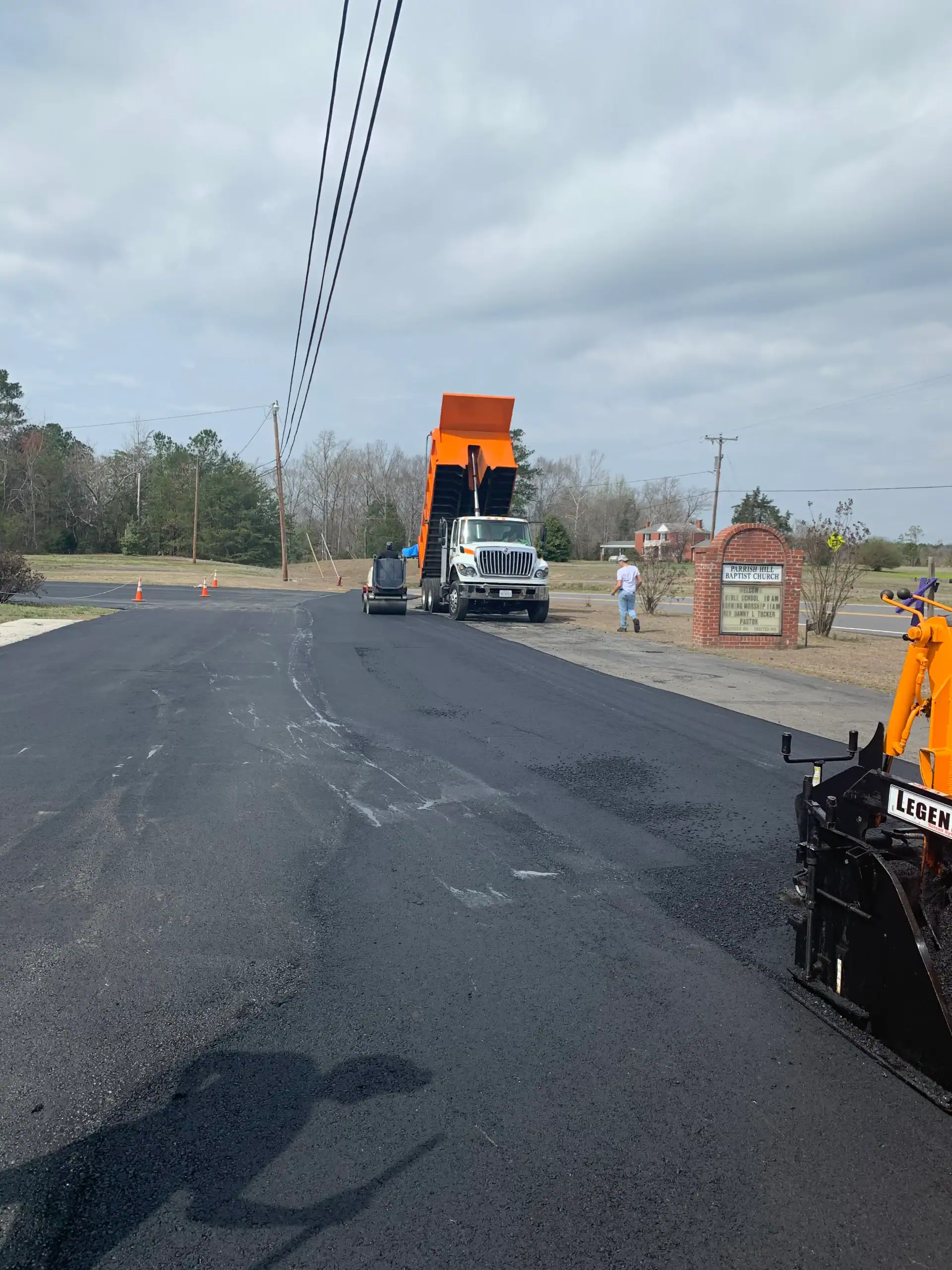
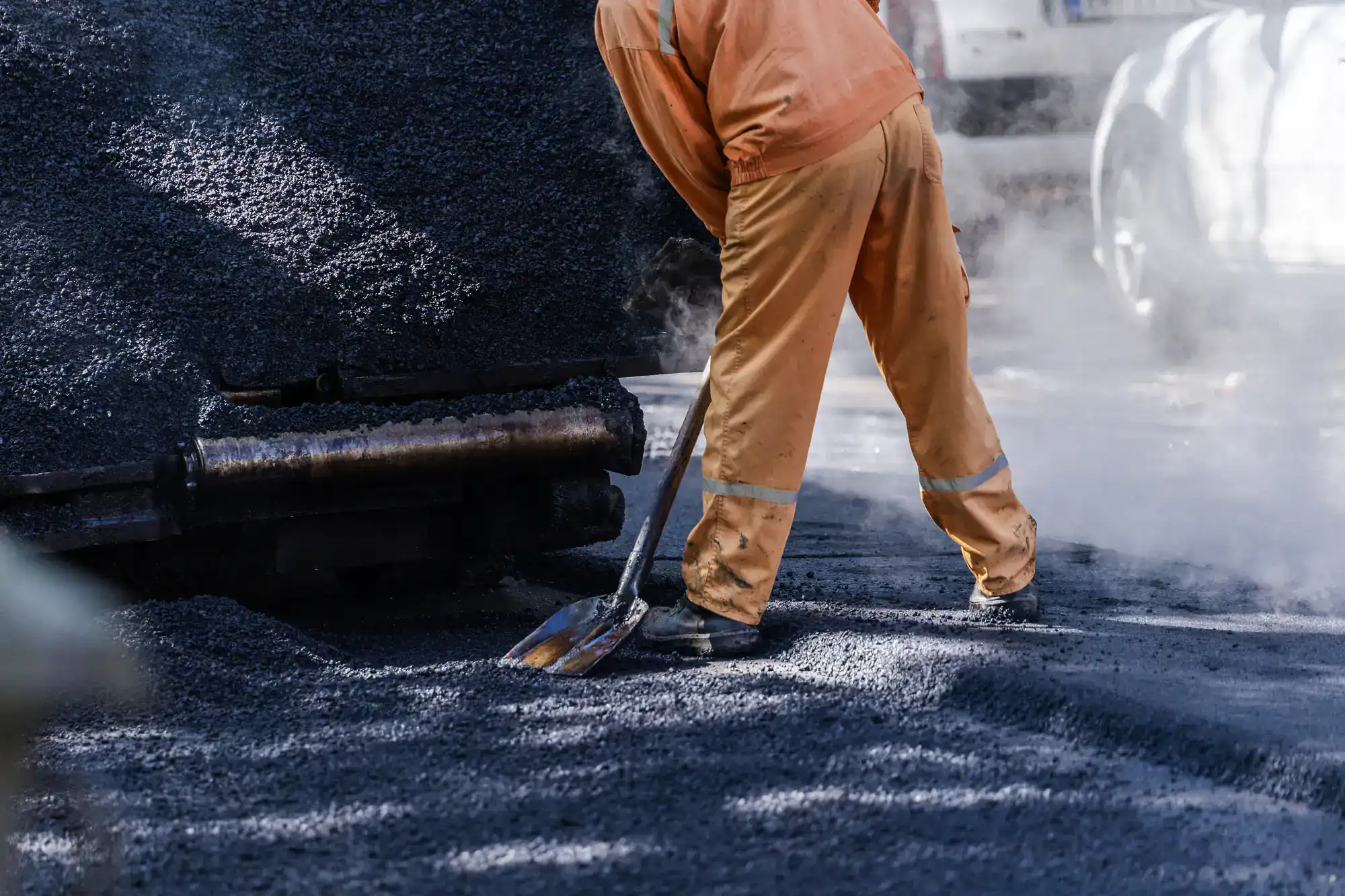
Hot mix asphalt is then applied in the specified thickness: commercial parking lots typically require two to three inches of compacted asphalt over the prepared base, though high-traffic areas and lots serving heavy vehicles often call for more. Compaction during this phase is critical. Asphalt has to be rolled and compacted while it’s still hot enough to be workable. Under-compaction is one of the leading causes of premature surface failure, and it’s not something you can see until the damage is already done.
After the surface cures, professional line striping completes the job: parking spaces, fire lanes, ADA-accessible spaces, directional arrows, and any other markings required for your property. A freshly paved lot without clean, precise striping is functionally incomplete, and it leaves you exposed to ADA compliance issues that carry real legal and financial consequences.
Here’s something that doesn’t get said enough: the mid-Atlantic climate is genuinely hard on asphalt, and Anne Arundel, Calvert, and St. Mary’s County sit right in one of the most demanding zones in the region. Our summers regularly push past 90 degrees with high humidity, and our winters deliver enough freeze-thaw cycling to do serious damage to any pavement that wasn’t installed correctly.
Freeze-thaw is the mechanism most people don’t fully understand. Water finds its way into small surface cracks, and there are always small cracks eventually. When temperatures drop below freezing, that water expands. When it thaws, it contracts. Every cycle widens the crack a little more. Over a Maryland winter, that process can repeat dozens of times, turning a hairline crack into a pothole and a minor drainage issue into a structural failure. If your base wasn’t properly compacted and graded to move water away from the surface, you’re accelerating that timeline significantly.
The Chesapeake Bay proximity that defines so much of this region also means elevated humidity year-round, which affects how asphalt cures and adds moisture stress to surfaces that might hold up fine in a drier climate. Properties along the waterfront in Chesapeake Beach, Solomons Island, or anywhere near the Patuxent River corridor in St. Mary’s County face a particularly demanding combination of summer heat, winter freeze-thaw, and coastal humidity. That’s not a reason to avoid paving; it’s a reason to make sure whoever you hire understands what they’re working with and specifies accordingly.
The Route 4 corridor through Prince Frederick and the commercial strips along Route 235 in Lexington Park see heavy daily traffic on top of these climate stressors. Lots serving that kind of volume need asphalt mix specifications and base depths appropriate for the load, not a one-size-fits-all approach that was designed for a suburban driveway.
Want live answers?
Connect with a Edward Smith Paving expert for fast, friendly support.
The paving industry has a documented problem with transient operators: crews that appear in the spring with a lowball offer, collect a deposit, do substandard work, and are unreachable when issues surface six months later. It happens every year across Maryland, and commercial property owners are not immune.
The good news is that Maryland gives you a straightforward way to protect yourself: verify the contractor’s MHIC license. The Maryland Home Improvement Commission requires any contractor performing paving work to hold an active license, and that license is publicly searchable through the Maryland Department of Labor. An MHIC-licensed contractor has passed background checks, demonstrated experience, carries minimum liability insurance, and is accountable to the state’s Guaranty Fund, which can reimburse consumers up to $30,000 if a licensed contractor fails to perform. That protection simply does not exist with an unlicensed operator.
Before you commit to any contractor, a few questions will tell you a lot about who you’re dealing with. Ask for their MHIC license number and look it up: it takes about two minutes and immediately separates legitimate contractors from those operating without accountability. Ask for proof of insurance, and make sure the coverage is appropriate for a commercial project. Ask for a written scope of work that specifies the asphalt mix, the compacted thickness, the base depth, and the timeline. If a contractor is reluctant to put those details in writing, that reluctance is your answer.
Ask about their experience with commercial projects specifically. Paving a parking lot that serves a medical office, a retail strip, or a defense contractor facility near NAS Patuxent River is a different undertaking than paving a residential driveway. Equipment requirements, mix specifications, ADA compliance considerations, and project management complexity are all different at commercial scale. A contractor who has completed thousands of projects over decades in this region will approach a commercial job differently than one who primarily does driveways.
It’s also worth asking how they plan to minimize disruption to your operations. A good commercial paving contractor thinks about your business, not just the asphalt. Can the project be phased to keep part of your lot accessible? What’s the realistic timeline from mobilization to when you can reopen the surface to normal traffic? These aren’t unreasonable questions: they’re the questions that distinguish a contractor who understands commercial work from one who’s scaling up from residential jobs and figuring it out as they go.
Finally, ask what happens after. Does the contractor offer a warranty? Will they come back if something needs attention? A contractor who is confident in their work will answer that question without hesitation. One who gets vague or evasive is telling you something important about what they expect the finished product to look like.
How much does commercial asphalt paving cost?
Commercial paving typically runs between $3 and $8 per square foot, depending on the size of the project, the existing site conditions, whether old pavement needs to be removed, and the specifications required for the traffic load. A 100,000-square-foot parking lot represents a significant investment, and the range between a properly done job and a cut-rate one can be substantial. Site preparation, drainage work, and complex grading can push costs higher. In Anne Arundel, Calvert, and St. Mary’s County, we’ve found that the most accurate way to understand your cost is to get an in-person quote from a contractor who has actually walked your property and understands the local climate and soil conditions.
When is the best time of year to pave in Anne Arundel, Calvert & St. Mary’s County?
The optimal window for asphalt paving in our region runs from roughly April through October, when ambient temperatures are consistently above 50 degrees and conditions support proper compaction and curing. Summer is peak season, which means scheduling fills up fast. If you want a fall project completed before the ground gets cold, start the conversation in late summer. Spring is also when most of the winter’s freeze-thaw damage becomes visible: potholes, cracked surfaces, and heaved pavement. Because of this, March through May tends to bring a surge in repair and resurfacing inquiries. Getting ahead of that rush means better scheduling and less waiting.
Do I need to replace my parking lot, or can it be repaired?
This depends on what’s actually happening beneath the surface, not just what you can see from the top. Isolated damage on otherwise sound pavement is a candidate for patching. But widespread cracking, particularly the interlocking, map-like pattern called alligator cracking, typically signals base failure, and patching over a failed base is a temporary fix that will cost you more in the long run. We can give you a clear assessment based on what we find, along with the reasoning behind our recommendation. If someone recommends full replacement without being able to explain why the base has failed, ask more questions.
How long does a commercial parking lot last?
A properly installed and maintained commercial asphalt surface can last 20 to 25 years. Without regular maintenance, particularly sealcoating every three to five years, that timeline can shorten significantly. The freeze-thaw cycling, UV oxidation from summer sun, and moisture stress from Chesapeake Bay humidity all accelerate deterioration on surfaces that aren’t being protected. Sealcoating is the single most cost-effective thing you can do to extend the life of an existing asphalt investment.
What are the ADA requirements for commercial parking lots? Commercial parking lots are required to include a minimum number of accessible parking spaces based on total lot capacity, with at least one van-accessible space. Those spaces must be the correct dimensions, properly marked, connected to an accessible route to the building entrance, and signed correctly. The specific requirements are set by the Americans with Disabilities Act and are not optional. Non-compliant lots expose property owners to complaints, inspections, and potential legal action. If your current lot has faded striping, missing signage, or spaces that don’t meet current dimensional standards, that’s worth addressing as part of any paving or resurfacing project.
The bottom line for any business owner in Anne Arundel, Calvert, or St. Mary’s County is this: commercial asphalt paving is a real investment, and the difference between a job that lasts 20 years and one that starts failing in five comes down almost entirely to who you hire and how they approach the work. It is essential to verify the license, get the scope in writing, ask about the base, ask about ADA compliance, and clarify what happens if something goes wrong.
We’ve been doing this for over 40 years, completed more than 5,000 projects across this region, hold an active MHIC license, and carry an A+ rating with the Better Business Bureau. We offer free in-person quotes and are ready to walk your property, answer your questions honestly, and give you a clear picture of what your project actually involves before any work begins. Contact us today to get started.
Summary:
Article details:
Share: