Parking lot safety is driving major shifts in commercial paving. Here's what property owners in Southern Maryland need to know before their next project.

Your parking lot is the first thing customers interact with before they ever reach your front door. And in Southern Maryland — where coastal humidity, hard winters, and heavy seasonal traffic take a real toll on asphalt — what they encounter out there says a lot about how you run your business. A cracked surface, a faded stripe, a pothole near the entrance: these aren’t just eyesores. They’re hazards, and in some cases, they’re liabilities. This page covers why safety has moved to the center of commercial paving decisions, what that looks like in practice, and what property owners in Anne Arundel, Calvert, and St. Mary’s Counties should be thinking about right now.
The paving industry has been tracking a clear trend: repair and maintenance revenues are growing fast, while new construction is leveling off. That’s not a coincidence. It reflects what commercial property owners are learning the hard way — that deferred maintenance doesn’t save money, it just moves the cost further down the road and makes it bigger when it arrives.
Safety is the reason this conversation has shifted from cosmetic to critical. Cracks let water in. Water freezes. Pavement fails. And when a customer trips, slips, or damages a vehicle in your lot, the question isn’t just how to fix the pavement — it’s how to handle the liability that comes with it. That reality is pushing property managers across Anne Arundel, Calvert, and St. Mary’s Counties to treat parking lot maintenance as a serious operational concern, not a line item to cut.

The Route 2 corridor running through Glen Burnie, Pasadena, Arnold, and into Annapolis is one of the most commercially active stretches in the state. Hundreds of retail storefronts, medical offices, restaurants, and service businesses line that route — and nearly every one of them depends on a functional parking lot to keep customers coming back. When those lots deteriorate, it’s not just an aesthetic problem. It’s a customer experience problem, a safety problem, and eventually a legal problem.
Here’s the math that most property owners don’t think about until it’s too late: sealcoating a commercial lot every two to three years costs a fraction of what resurfacing costs. Resurfacing costs a fraction of full replacement. And full replacement — which becomes necessary when water infiltration has compromised the subbase — can run many times what proactive parking lot maintenance would have cost over the same period. A lot that’s properly maintained can last 20 to 30 years. One that’s neglected may need complete reconstruction in half that time.
Beyond the financial side, there’s the liability exposure. Potholes, uneven surfaces, and standing water after rain are all documented slip-and-fall and vehicle damage risks. In a state like Maryland, where commercial property owners are expected to maintain safe premises, a deteriorated parking lot is a documented hazard — and that matters in court. The Annapolis area sees a high volume of foot traffic from tourism, the Naval Academy, and state government activity, which means your lot isn’t just serving regulars. It’s serving people who have no particular loyalty to your business and every reason to hold you accountable if they get hurt.
Addressing pavement issues early — crack filling, pothole repair, proper drainage corrections — keeps those risks manageable. Waiting until the lot is visibly failing means you’re already behind.
ADA requirements for commercial parking lots aren’t new, but the 2025 standards have made them more specific and harder to ignore. The law requires a minimum number of accessible parking spaces based on your total lot size, and those spaces must meet precise dimensional standards, be clearly marked, have compliant signage, and maintain surface conditions that are safe for people using mobility aids. Failing to meet those standards doesn’t just create a safety problem — it creates a federal compliance problem.
For commercial property owners in Anne Arundel County, this is particularly relevant given the density of medical offices, government buildings, and retail centers in communities like Crofton, Odenton, and Severna Park. These properties serve a broad cross-section of the public, including people with mobility limitations, and the expectation of accessible, well-maintained parking is both a legal requirement and a basic standard of service.
In St. Mary’s County, the commercial build-out around Lexington Park and California, MD — driven largely by the defense industry and the businesses that support NAS Patuxent River — has created a significant inventory of parking lots that were built in the 2000s and are now approaching or past their first major maintenance window. Many of those lots were striped to older standards. Bringing them into current ADA compliance as part of a resurfacing or parking lot maintenance project is far more cost-effective than addressing compliance separately after the fact.
Proper striping isn’t just paint. It’s fire lane designation, pedestrian crosswalk marking, directional flow, and accessible space identification — all of which contribute to how safely and efficiently your lot functions. When striping fades or disappears, drivers make up their own rules, and that’s when accidents happen.
Want live answers?
Connect with a Edward Smith Paving expert for fast, friendly support.
Saying a paving project is “safety-focused” is easy. Delivering one requires more than fresh asphalt. It starts before any equipment arrives on site, with a thorough assessment of what’s actually causing the problems you can see — and the ones you can’t yet.
Drainage is usually the place to start. Poor drainage is one of the most common causes of parking lot failure, and it’s one of the most overlooked. A properly designed lot should slope at roughly two percent from crown to edge, directing water away from the surface and toward drainage structures. When that slope is off — or when drainage structures are blocked or missing — water sits, seeps in, and starts breaking down the pavement from the inside out.

The visible surface of a parking lot is only part of the story. What’s underneath — the subgrade, the aggregate base, the binder course — is what determines how long that surface holds up under real-world conditions. A lot that looks fine on top but has a compromised subbase is already failing. You just can’t see it yet.
This is especially true in Southern Maryland, where the combination of coastal humidity, freeze-thaw cycling, and significant rainfall events creates ideal conditions for subsurface water damage. The Chesapeake Bay watershed covers all three counties we serve — Anne Arundel, Calvert, and St. Mary’s — and the environmental conditions that come with that geography are hard on pavement in ways that aren’t always obvious until the damage is well advanced.
In Calvert County, many commercial properties along the MD-2/4 growth corridor between Dunkirk and Prince Frederick were built during the development boom of the 2000s. Those lots are now 15 to 20 years old, which is exactly when subbase issues start showing up as surface cracking, rutting, and drainage problems. Addressing those issues with a proper mill-and-overlay or targeted base repair — rather than just patching the surface — is the difference between a fix that lasts and one that fails again in two years.
In communities like Solomons Island and Chesapeake Beach, where seasonal tourism drives high parking lot traffic during warmer months, the wear pattern is compressed. Lots that see light use most of the year take a beating during peak season, and the combination of heavy traffic and summer heat softens asphalt that hasn’t been properly maintained. Sealcoating and regular inspections keep those lots from deteriorating faster than they should.
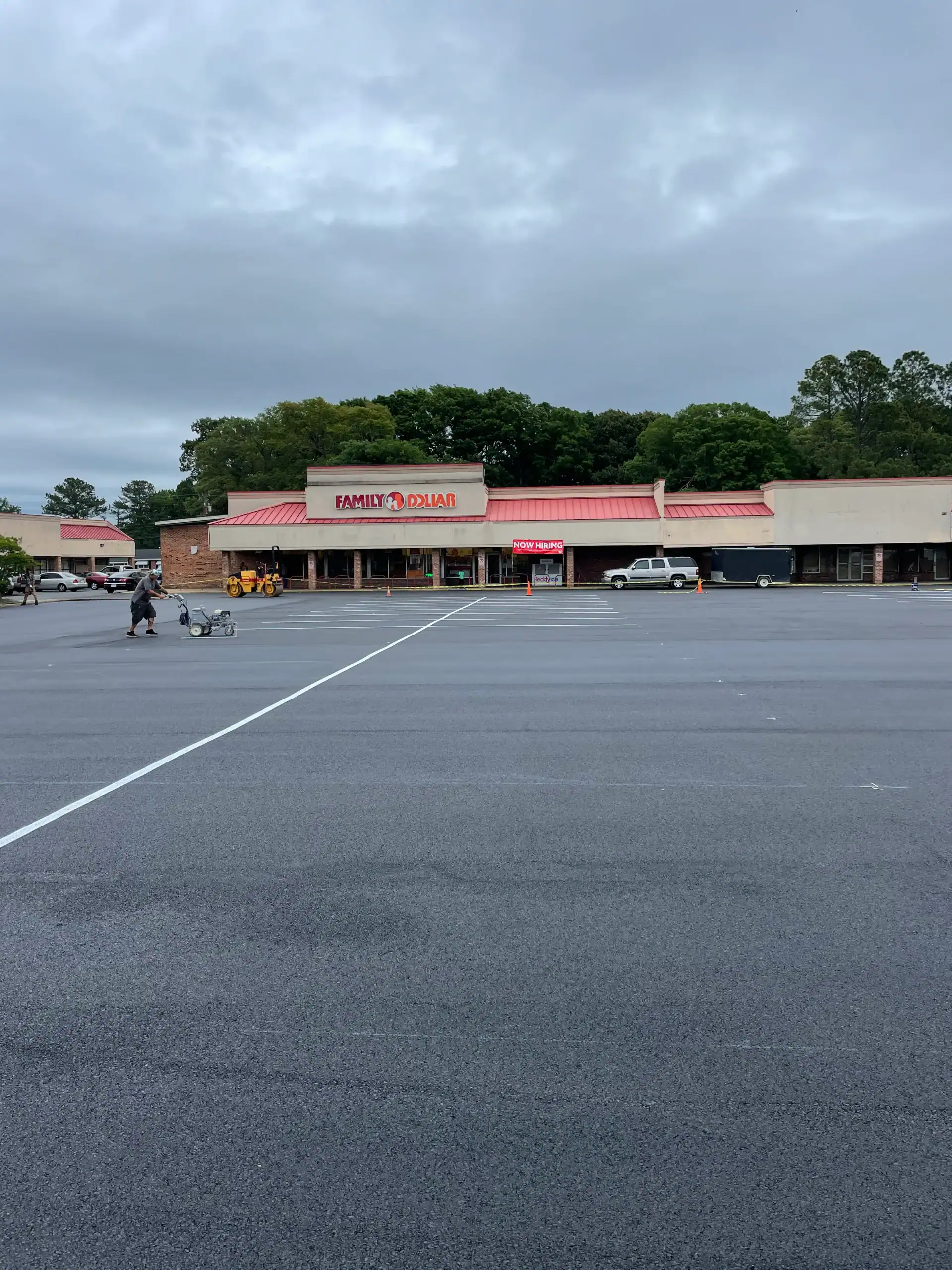
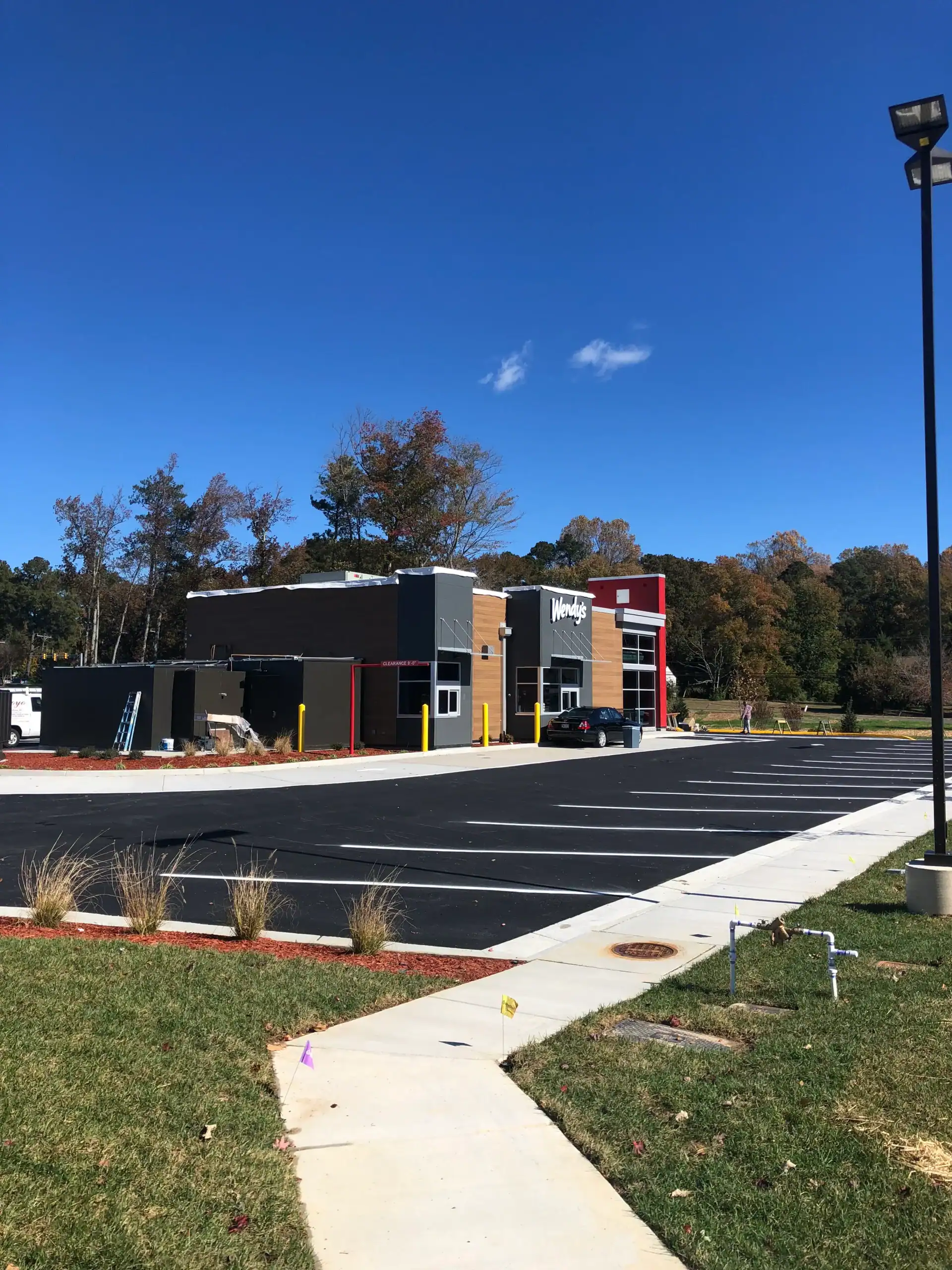
Fresh pavement without proper striping is an incomplete job. Parking lot striping is what turns an asphalt surface into a functioning, safe parking facility — and when it fades, the safety of everyone using that lot starts to erode along with it.
Clear lane markings tell drivers where to go and where not to go. Pedestrian crosswalk markings tell drivers where to expect foot traffic. Fire lane designations keep emergency access clear. ADA-compliant accessible space markings — including the required access aisles and van-accessible designations — protect both your customers and your business from liability. When any of these fade or disappear, you’re not just dealing with an aesthetic issue. You’re dealing with a lot that no longer communicates the rules clearly, and that’s when people get hurt.
For commercial properties in the Annapolis area, where tourism and state government activity bring a steady flow of unfamiliar visitors to parking lots throughout the year, clear striping is especially important. A visitor who doesn’t know your property is relying entirely on what the pavement tells them. Faded or missing markings leave too much to chance.
The same applies in Leonardtown and the growing commercial districts of St. Mary’s County, where newer retail and mixed-use development is attracting customers from across the county. These properties are building their reputations, and a well-organized, clearly marked parking lot is part of the first impression they’re making. It’s also part of the compliance picture — Maryland’s commercial property standards expect maintained, legible striping, and the cost of restriping a lot is small compared to the cost of a single ADA complaint or personal injury claim.
We handle parking lot striping as part of a complete commercial paving maintenance approach — not as an afterthought. When we resurface or sealcoat a lot, restriping is part of the process, and we do it to current ADA and fire code standards.
If your parking lot has visible cracking, faded striping, standing water after rain, or potholes that keep coming back, those aren’t isolated problems — they’re signs that the lot needs a professional assessment, not another round of DIY patching.
The good news is that most commercial lots, when caught before they reach full structural failure, can be rehabilitated at a fraction of the cost of replacement. The key is getting an honest evaluation from someone who knows what to look for and isn’t going to oversell you on work you don’t need.
We’ve been doing this work across Southern Maryland for over 40 years, with more than 5,000 paving projects completed and an MHIC license and BBB A+ accreditation to back it up. If you own or manage a commercial property in Anne Arundel, Calvert, or St. Mary’s County and you’re not sure where your lot stands, we offer free site assessments and no-pressure quotes. Reach out and we’ll take a look.
Summary:
Article details:
Share: