Potholes don't always mean you need a full replacement. Here's how to read what your asphalt is actually telling you — and what to do next.
You’ve been staring at that pothole for a few weeks now. Maybe it started as a small crack after last winter, and now it’s turned into something you can’t ignore. The question isn’t whether it needs attention — it’s what kind of attention it actually needs. A patch? A full resurface? Something else entirely? Getting that wrong either way costs you money. Patch a surface that needed resurfacing and you’ll be making that call again next spring. Resurface when a simple repair would’ve done the job and you’ve overspent. Here’s how to think through it clearly.
Maryland’s winters are the main culprit. When water seeps into a crack in your asphalt and the temperature drops below freezing, that water expands — by about 9% — and pushes the pavement upward. When it thaws, it contracts and leaves a gap beneath the surface. Traffic rolls over that weakened spot, the surface gives way, and a pothole forms. Maryland and Central and Northern Virginia’s own public works department describes it plainly: streets can seem to break out in potholes overnight during this cycle.
What makes this worse in Calvert County and St. Mary’s County is the soil. Much of the region sits on clay-heavy ground that expands when wet and contracts when dry. That movement puts additional stress on your asphalt from below, even before winter enters the picture. Add in the year-round humidity from the Chesapeake Bay and Patuxent River, and you have an environment that is genuinely hard on paved surfaces.
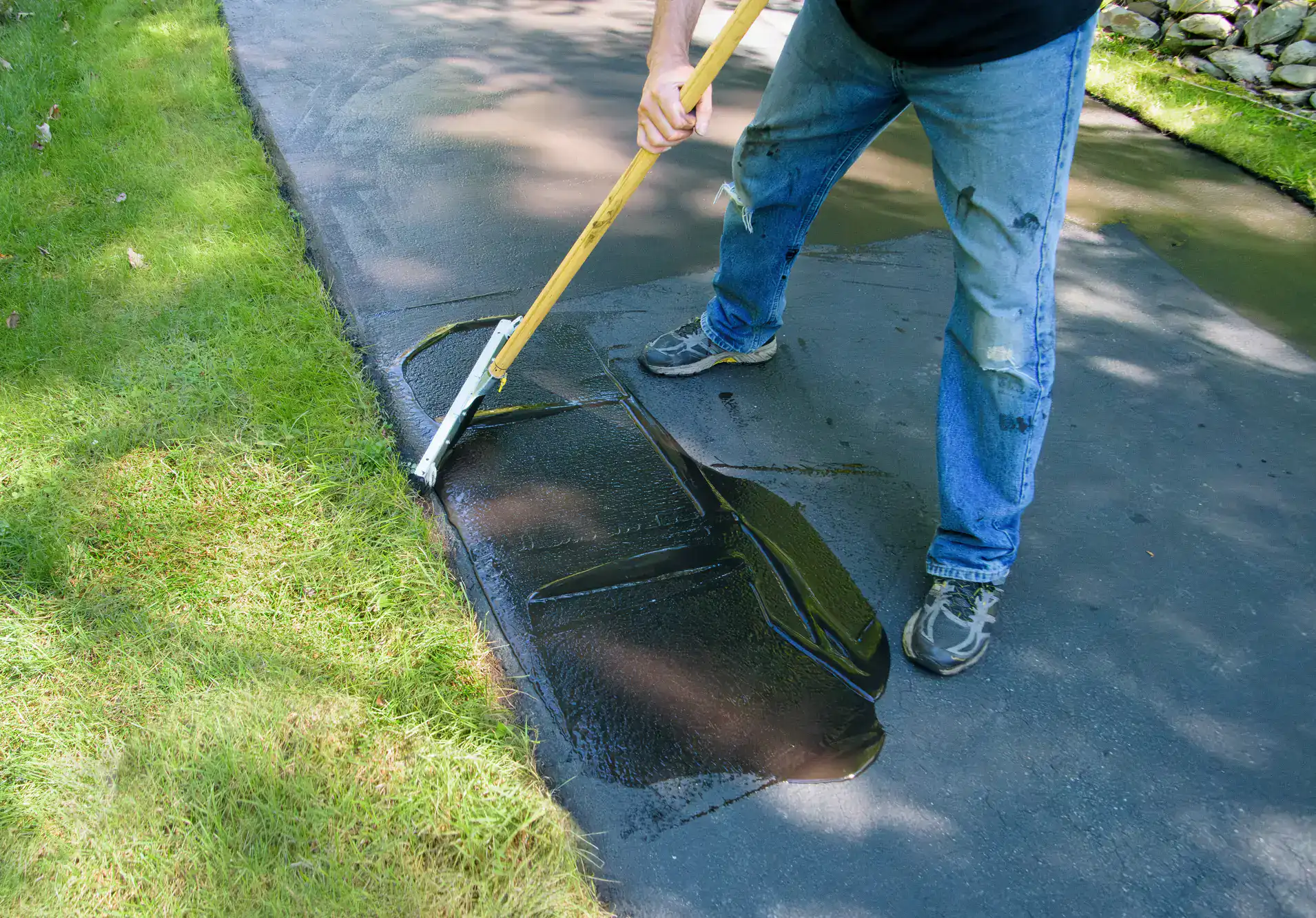
This is the question that actually determines what kind of repair you need — and it’s the one most homeowners and property managers can’t answer without a professional assessment. Surface damage and structural damage can look similar from above, but they require completely different responses.
Surface-level damage includes things like fading color, hairline cracks from thermal expansion, shallow potholes with clean edges, and minor crumbling along the edges of a driveway. These are signs that your asphalt is aging and drying out, but the foundation underneath is still doing its job. In these cases, crack filling, pothole patching, and sealcoating can extend the life of your pavement significantly — often by several years — without the cost of a full resurface.
Structural damage is a different story. If you’re seeing what’s called alligator cracking — that interconnected web of cracks that looks like, well, alligator skin — that’s a sign the base layer has failed. The same goes for potholes that keep coming back in the same spot after being repaired, soft or spongy spots when you walk across the surface, or areas where the pavement has shifted, heaved, or sunk. These are symptoms of a sub-base problem, and laying fresh asphalt over a compromised base is one of the most expensive mistakes you can make. The new surface will fail faster than the old one did.
One useful benchmark: when roughly 25% or more of a paved surface shows visible distress — cracking, rutting, patching, or potholes — repairs alone typically stop being cost-effective. At that point, resurfacing or replacement becomes the smarter long-term investment. If you’re below that threshold and the damage is isolated, targeted pothole repair is usually the right move.
These three terms get used interchangeably, but they’re not the same thing — and understanding the difference helps you have a more informed conversation with any contractor.
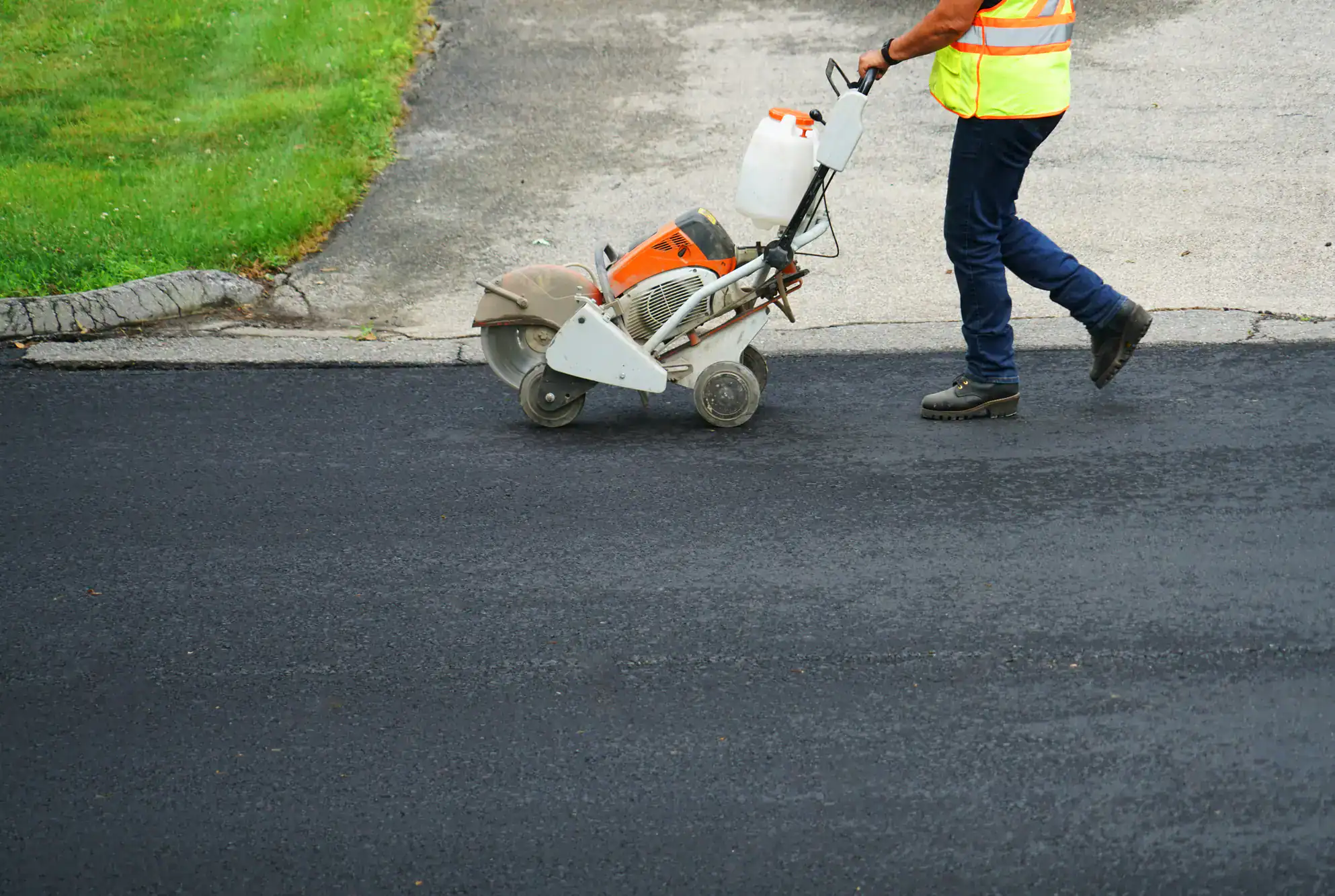
Pothole repair, done correctly, means saw-cutting clean edges around the damaged area, removing the compromised material down to stable ground, addressing any base issues, and filling with hot-mix asphalt that’s properly compacted. Cold-patch products from a hardware store are a temporary band-aid — they’re fine for getting through a season, but they’re not a permanent fix. A professional repair with the right materials and technique can last four to five years in a residential driveway, or two to three years in a high-traffic commercial lot.
Resurfacing — sometimes called an overlay — means applying a new layer of asphalt (typically about two inches thick) over your existing surface after a bonding coat is applied. It’s a strong option when the base is structurally sound but the surface has aged past the point where patching makes sense. Resurfacing costs significantly less than full replacement — roughly $1 to $3 per square foot compared to $4 to $10 for a complete tear-out and rebuild — and it can add eight to fifteen years of life to a driveway or parking lot.
Full replacement is the right call when the base has failed, when drainage problems have compromised the sub-base, or when more than half the surface is damaged. It costs more upfront, but it’s the only option that actually solves a structural problem. A general rule of thumb: if your repair costs are going to exceed half the price of full replacement, the math usually favors starting fresh.
Want live answers?
Connect with a Edward Smith Paving expert for fast, friendly support.
The answer isn’t always obvious, and it shifts depending on the age of your pavement, how it’s been maintained, and what kind of traffic it handles. A well-maintained driveway can last 20 to 25 years. One that’s been neglected may need replacement in 10 to 12 years — cutting its functional life nearly in half.
For homeowners in Annapolis, Crofton, Severna Park, Edgewater, Dunkirk, Huntingtown, or Owings who are dealing with isolated potholes and a surface that’s otherwise intact, targeted pothole repair is the right starting point. For commercial property owners in Lexington Park, Prince Frederick, Glen Burnie, or along Route 2 in Maryland and Central and Northern Virginia whose parking lots are showing widespread cracking and recurring damage, resurfacing or replacement deserves a serious look.
Small problems become expensive ones faster than most people expect. A pothole that goes unaddressed through one Maryland winter will almost always be larger by spring. Water continues to infiltrate the gap, the freeze-thaw cycle does its work again, and what started as a manageable repair becomes a structural issue that requires a much more significant investment.
For residential homeowners in Calvert County and St. Mary’s County — where long private driveways are common — ignoring early-stage damage means eventually replacing hundreds of feet of pavement rather than repairing a section of it. That’s a meaningful cost difference.
For commercial property owners, the stakes are higher. Potholes in a parking lot aren’t just a maintenance issue — they’re a liability issue. Vehicle damage and trip-and-fall injuries are real risks that fall on the property owner. Businesses near NAS Patuxent River in St. Mary’s County, retail properties in Prince Frederick, or office parks in Glen Burnie all carry the same exposure: if someone gets hurt because of a pothole on your property, that’s your problem to answer for. Staying ahead of the damage is almost always cheaper than dealing with the consequences of ignoring it.
Sealcoating is one of the most effective tools for preventing this cycle from starting in the first place. Applied every two to three years to sound asphalt, it seals out water, protects against UV oxidation, and significantly slows the deterioration that leads to cracking and pothole formation. It won’t fix existing damage, but it’s one of the best investments you can make in asphalt that’s still in good shape.
The paving industry has more than its share of operators who cut corners — on materials, on base preparation, on compaction, or on the assessment process itself. The result is repairs that fail within a season and customers who end up calling someone else to fix what the first contractor got wrong. We’ve done exactly that for more homeowners and property managers than we can count.
The most important thing to verify before hiring anyone for pothole repair or resurfacing in Maryland is their MHIC license. The Maryland Home Improvement Commission requires any contractor performing home improvement work valued at $500 or more to carry a valid license. It’s a public record — you can look it up. An unlicensed contractor has no accountability to you if the work fails. We carry MHIC License #159766, valid through August 2026, and we’re happy for you to verify it.
Beyond licensing, ask how the contractor assesses the job before quoting it. A contractor who gives you a price over the phone without looking at the base condition is guessing. The right answer depends on what’s happening beneath the surface, and that requires an in-person look. We’ve been doing this for over 40 years and have paved more than 5,000 driveways across Anne Arundel, Calvert, and St. Mary’s counties — not because we always recommend the most expensive option, but because we tell people what they actually need. Sometimes that’s a patch. Sometimes it’s a resurface. Occasionally it’s a full replacement. The assessment drives the recommendation, not the other way around.
If you’ve been burned by a cheap repair that didn’t hold, or if you’ve gotten conflicting advice from different contractors, a straightforward in-person assessment is the place to start. There’s no cost to it, and it takes the guesswork out of a decision that has real financial consequences either way.
The bottom line is this: not every pothole means you need a new driveway, and not every crack can be fixed with a bag of cold patch from the hardware store. The right answer lives somewhere in between, and it depends on your specific surface, your base condition, and how much useful life your asphalt realistically has left.
Maryland’s climate — the freeze-thaw cycles, the clay soils, the coastal humidity — makes this decision more time-sensitive than it might be elsewhere. Waiting tends to make things worse and more expensive.
If you’re in Maryland and Central and Northern Virginia, Calvert County, or St. Mary’s County and you’re trying to figure out what your asphalt actually needs, we offer free, in-person assessments with no obligation. We’ll look at the surface, evaluate the base, and give you a straight answer — not a sales pitch.
Summary:
Article details:
Share: