
Hear from Our Customers
In the Northern Shenandoah Valley, winter doesn’t just bring snow — it brings repeated freeze-thaw cycles that widen micro-cracks into structural damage season after season. By the time a property owner near Clear Springs notices the problem in March, what started as surface cracking in October has often become a base issue that no sealcoat will fix.
Getting the asphalt right from the start is what separates a lot that lasts twenty years from one that needs attention every five. For commercial properties in the Clear Springs area — whether you’re running a farm supply operation off Route 11, managing a light industrial facility, or overseeing a rural commercial building that sees regular truck traffic — the asphalt spec matters.
Commercial lots need 4 to 6 inches of asphalt minimum, and the base underneath needs to be engineered for what’s actually driving on it. A residential-grade job under heavy axle loads won’t survive a Shenandoah Valley winter. What you end up with, when the work is done right, is a surface that drains correctly, holds up under load, and doesn’t demand emergency repairs every spring.
That’s not dramatic — it’s just what a properly built commercial parking lot should do. The difference is in the base preparation, the mix design, and the drainage engineering that happens before a single ton of asphalt gets laid.
We’ve been doing commercial asphalt work for over 40 years, with more than 5,000 projects completed across Maryland and Virginia. We’re based in Annapolis and hold Maryland MHIC License #159766, along with BBB Accreditation and an A+ rating — credentials that are published and verifiable before you sign anything.
Serving the Clear Springs area means operating in Frederick County’s rural commercial environment — a market that’s different from suburban Maryland in meaningful ways. Properties here are often owner-operated, the terrain involves clay-heavy soils and seasonal moisture variability, and commercial lots regularly absorb agricultural and light industrial truck traffic that a standard residential paving crew isn’t equipped to handle.
We bring commercial-grade specifications and honest project assessments to every job in this region. Every quote starts with an in-person site visit. We assess base condition, drainage, traffic load, and ADA requirements on the ground before any number is given. That’s how accurate estimates get built — and it’s the part of the process that customers consistently point to when they describe why they called back.
It starts with a site visit. We come out, walk the property with you, and look at what you’re actually dealing with — existing base condition, drainage patterns, traffic load, ADA requirements, and whether the scope is a repair, a resurfacing, or a full new installation. That assessment drives the recommendation.
If crack sealing is the honest answer, that’s what we propose. If the base is failing and a full replacement is needed, that gets explained clearly with the reasoning behind it.
Once the scope is agreed on, we plan the project around your business hours. For owner-operated commercial properties in the Clear Springs area, a parking lot closure that shuts out customers isn’t acceptable — so the work gets planned in sections that keep access open throughout the project.
The paving phase itself — hot mix application, compaction, and grading — typically runs one to three days for a standard commercial lot. New asphalt is ready for vehicle traffic within 48 to 72 hours. From there, the conversation shifts to the maintenance cycle: sealcoating every three to five years, annual crack filling as needed, and ADA-compliant striping — all handled under one ongoing relationship so you’re not sourcing separate vendors every time the lot needs attention.
Ready to get started?
We handle the full commercial pavement lifecycle — new lot construction, full-depth replacement, asphalt overlay and resurfacing, crack sealing, pothole repair, sealcoating, and parking lot striping. For commercial property owners in the Clear Springs area who are already managing a full slate of operational responsibilities, not having to source and vet separate vendors for every phase of the pavement lifecycle is a real practical advantage.
ADA compliance is built into every commercial project from the start. We engineer accessible spaces, compliant slopes, correct signage placement, and proper access aisle widths into the layout — not added as an afterthought. Older commercial properties in rural Virginia were frequently built before ADA enforcement was rigorous, and a lot that looks functional may not meet current standards. Getting it right during a repave or resurfacing project is significantly less expensive than retrofitting it later under pressure.
For industrial and agricultural properties in the Frederick County area that see regular heavy truck traffic, the asphalt specification gets adjusted accordingly. Commercial-grade thickness and engineered base preparation for heavy axle loads are standard on these projects — not an upgrade. The valley’s clay-heavy soils and seasonal moisture also factor into subgrade preparation, because a base that isn’t designed for local soil conditions will shift and settle regardless of what gets paved on top of it.
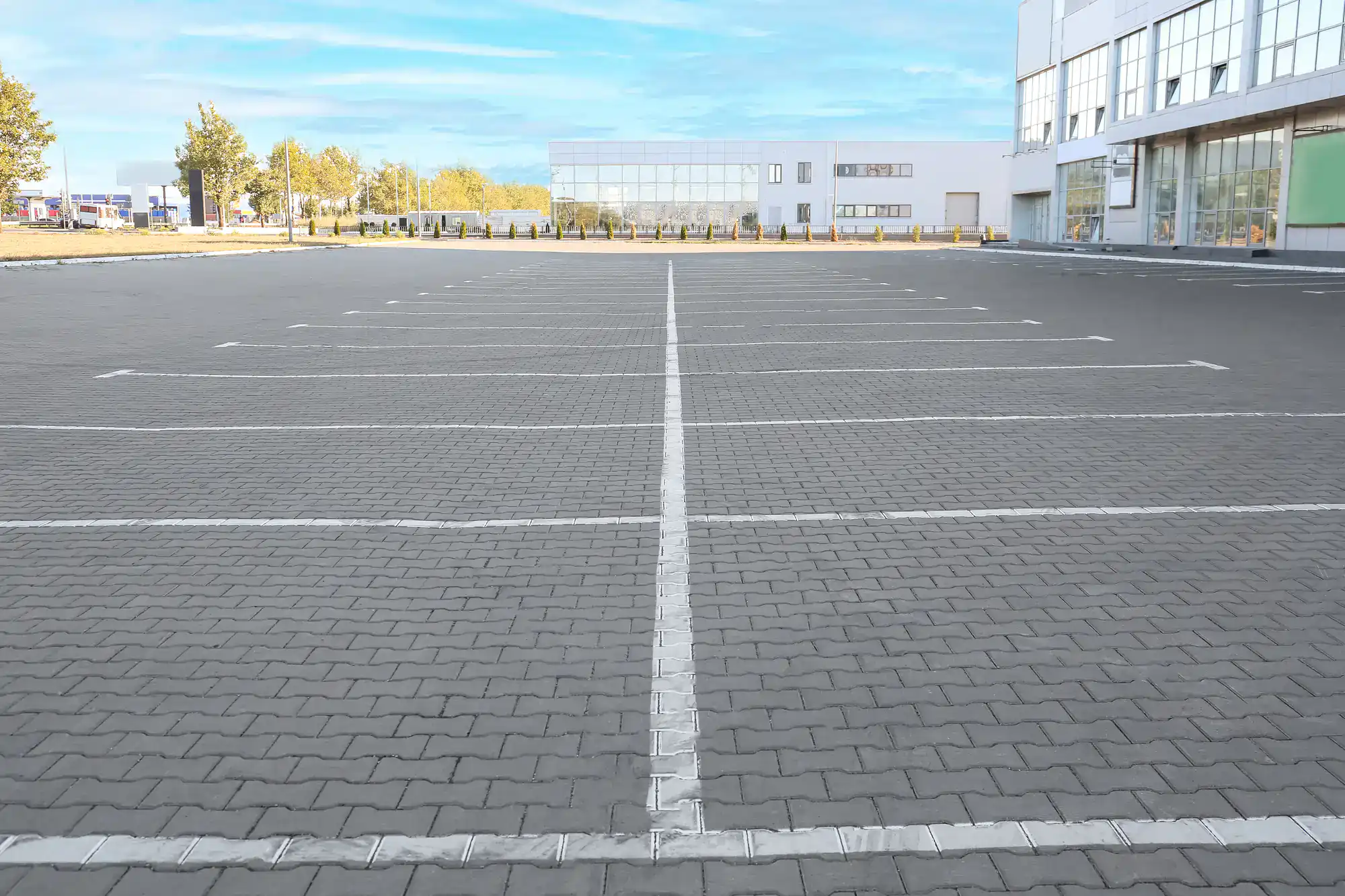
The honest answer depends on whether the damage is surface-level or structural — and that distinction matters a lot in terms of cost and long-term outcome. Surface cracking, faded striping, and minor potholes are typically addressable with crack sealing, patching, or a sealcoat application. If the base underneath is compromised — which shows up as alligatoring, significant heaving, or widespread structural cracking — an overlay or full replacement is the right call.
Applying a surface treatment over a failing base is one of the most common causes of premature pavement failure. In the Northern Shenandoah Valley, the freeze-thaw cycle accelerates this progression. A lot that had manageable surface cracking going into October can look significantly worse by March after a full winter of water infiltrating those cracks, freezing, expanding, and reopening them.
The best way to get an accurate read on where your lot stands is a proper on-site assessment — not a drive-by estimate. We walk every commercial property before making a recommendation, because the right scope can only be determined from the ground.
For a standard commercial lot, the hot mix asphalt application, compaction, and finish work typically runs one to three days. Larger projects, or those requiring significant subgrade work, drainage corrections, or phased scheduling around business hours, will take longer — but we map that out during the planning phase so you know the timeline before work begins.
New asphalt is generally ready for vehicle traffic within 48 to 72 hours of installation. If the project includes sealcoating after paving, vehicle traffic can typically resume within 24 to 48 hours of the sealer application.
For standard commercial vehicle traffic — passenger cars, light trucks, delivery vans — a commercial lot typically needs a minimum of 4 inches of compacted asphalt over a properly prepared base. For properties in the Clear Springs area that see regular heavy truck traffic, agricultural equipment, or loaded delivery vehicles, 5 to 6 inches or more is the appropriate specification.
Each additional inch of asphalt adds roughly $0.50 to $1.00 per square foot in material cost, but it’s not an optional upgrade when the traffic load demands it — it’s what determines whether the lot holds up or starts failing within a few years. The base preparation underneath the asphalt is just as important as the surface thickness.
Frederick County’s clay-heavy soils retain moisture and shift seasonally, which means subgrade compaction and drainage engineering directly affect how long the finished surface performs. A properly specified commercial lot in this climate, with the right base and the right asphalt thickness for the actual traffic load, can realistically last 20 to 30 years with routine maintenance. Cut corners on either, and that number drops significantly.
Yes — ADA compliance applies to any commercial facility that provides goods or services to the public, and it covers more than just painting a wheelchair symbol on the pavement. Compliant accessible parking requires the correct number of designated spaces based on total lot size, proper space and access aisle dimensions, slope limits on both the parking surface and the access aisle, compliant curb ramps where applicable, and correct signage placement and height.
Federal law requires one accessible space for every 25 total spaces up to 100 spaces, with the ratio adjusting for larger lots. Many older commercial properties in rural Virginia — including properties in the Clear Springs area — were built or last repaved before ADA enforcement was consistently applied in rural markets. If your lot hasn’t been assessed recently, there’s a reasonable chance the striping, slopes, or signage don’t meet current standards.
We design ADA compliance into every commercial paving project from the layout stage, so you’re not dealing with a retrofit conversation six months after the job is done.
The primary paving season in the Northern Shenandoah Valley runs from April through October. Hot mix asphalt requires ambient temperatures above 50°F and rising to install and compact correctly — once temperatures drop into the fall, the installation window closes. The valley’s elevation and mountain-flanked geography mean that fall temperatures drop earlier here than in coastal Maryland or Northern Virginia suburbs, which makes the October window tighter than it might seem.
Spring is the most common time for property owners to recognize the need for paving work, because winter freeze-thaw damage becomes fully visible as temperatures stabilize. That’s also when demand peaks and scheduling fills up quickly. If you’re planning a new installation or a significant repaving project, get the assessment done in late winter and schedule the project for early-to-mid spring to get ahead of the seasonal rush.
We handle the full commercial pavement lifecycle — new installation, sealcoating, crack filling, and ADA-compliant striping — under one ongoing relationship. For commercial property owners in the Clear Springs area who are already managing a full slate of operational responsibilities, not having to source and vet separate vendors for every phase of the pavement lifecycle is a real practical advantage.
Sealcoating should be applied every three to five years to protect the asphalt surface from UV degradation, moisture infiltration, and the oxidation that makes asphalt brittle over time. In the Shenandoah Valley’s climate, where freeze-thaw cycles put consistent stress on pavement surfaces, staying on that maintenance schedule is what extends a lot’s useful life from the lower end of the range toward the upper end.
Crack filling on an annual basis catches damage before it progresses to the point where a more expensive intervention is needed. Having one contractor who knows the history of the lot, the original installation spec, and the maintenance schedule means the work gets done in the right sequence — not reactively, after the damage is already structural.
Other Services we provide in Clear Springs